

Men’s vs women’s glasses: In most stores, frames are organized into two worlds: “men” on one side, “women” on the other. The same logic appears online, in filters and menus. This separation shapes the offer, the collections, and the way customers enter the selection process.
This guide examines what that segmentation actually covers by separating three levels that are often confused: fit (measurable), design (codes), and industry (merchandising, sizing, stock). The goal is to make eyewear easier to read through concrete parameters: proportions, balance on the face, measurement systems, and range consistency.
The thread running through this guide is deliberately stable: how a frame holds depends first on dimensions and geometries, then on aesthetic choices and presentation conventions. In practice, a proportion-based reading explains success and failure on the face more clearly than a label-based reading.
What this guide clarifies
- Fit / proportions: face width, bridge (DBL), temples, contact points, stability.
- Design / codes: shapes, volumes, thicknesses, colors, visual signals.
- Industry / retail: assortment, segmentation, planograms, navigation, e-commerce filters.
Guide contents
- Men’s / women’s glasses: real difference or marketing construction?
- Eyewear sizing: understanding the essential dimensions
- Glasses that slip: balance on the face (nose, ears, proportions)
- Why do stores separate men’s and women’s glasses?
- Unisex glasses: trend or structural evolution?
- How to choose glasses based on the width of your face
Quick reading of the 6 articles
1) Men / women: what is measurable, what is coded, what is organized
Overall framework. This article distinguishes differences that may exist at the level of sizing and geometry (with significant overlap), style codes, and industrial interests tied to how the offer is structured.
2) Dimensions: how to read A–DBL–temples without relying on the wrong indicator
Technical foundation. How to read 52-18-140, the role of each measurement, the limits of engraved numbers, and how they connect with S/M/L/XL references and oversized frames when oversize reflects a deliberate design intention.
3) Slipping: a symptom that reveals a proportion problem
Operational diagnosis. Three areas govern hold: nose support, retention behind the ear, and front-to-back balance. This article separates what can be solved through adjustment from what comes from the wrong frame geometry.
4) Stores: men’s/women’s separation as a merchandising tool
Retail reading. Segmentation primarily serves to make an assortment legible and to manage product families. It often classifies style worlds and navigation habits more than technical needs.
5) Unisex: when the label becomes a range architecture
Turning point. “Unisex” becomes structural when the construction stays constant and sizes/proportions vary explicitly: width grids, consistent bridges, visible measurements, and usable filters.
6) Selection method: start with face width, then validate bridge and temples
Decision guide. Face width works as the starting reference, then the bridge stabilizes support and the temples secure retention. This method reduces mistakes caused by labels and approximations.
Editorial method
This guide treats eyewear as both a technical and cultural object. Each article crosses measurement vocabulary, construction logic, and observation of market uses. The goal is not to erase categories, but to describe their function and their limits, then place back at the center what actually determines how a frame wears.
Stable reference points to keep in mind
- Fit depends on concrete parameters: width, bridge, temples, balance.
- Style organizes visual codes without guaranteeing hold.
- Retail classifies in order to make the offer navigable, not to describe an individual morphology.
- Credible unisex eyewear relies on constant construction and explicit sizing.
Men’s vs Women’s Glasses: A Proportion-Based Guide
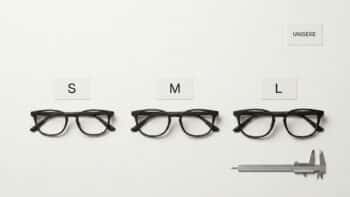
The word “unisex” is everywhere in eyewear. It can refer to a style, an intention, or a way of classifying a collection. It can also conceal a less simple reality: no frame suits everyone. Faces vary in width, noses vary in height and shape, ears vary in position, and stability depends on wearing geometry. To […]
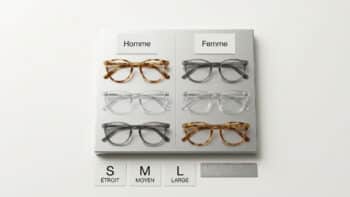
In many optical shops, the “Men” / “Women” split feels obvious. It reassures, guides, and speeds up decisions. Yet frame stability depends mostly on fit variables (overall width, bridge, temples) and design codes (shapes, volumes, color). So why does this sorting persist—even when collections claim to be unisex? The answer isn’t “marketing vs truth.” Separating […]

Glasses keep slipping is a simple symptom: you keep pushing the frame up, your eye line breaks, and a good-looking front becomes unusable. The cause is rarely “mysterious.” A frame stays put when its geometry creates a stable balance across three zones: nose support, retention behind the ears, and weight distribution between front and back. […]
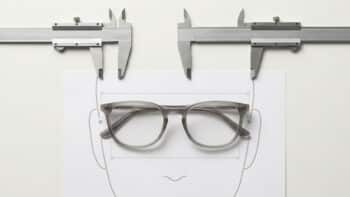
How to choose glasses for face width without guessing: face width is the most useful reference point. It drives stability (they stay put or they slide), alignment (the frame stays centered), and the visual outcome (proportions look balanced or forced). Style comes after: a shape can look perfect, but if width is out of tolerance, […]
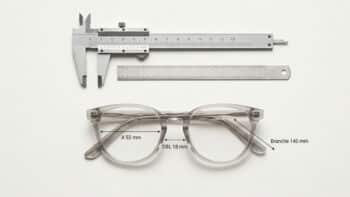
Glasses size is often reduced to a string of numbers printed inside the temple. Yet those dimensions drive comfort, stability, and the visual balance of a frame. Understanding them lets you read eyewear as a set of proportions—not a marketing label. Lens width, bridge width, temple length: each value has a specific role. Before style, […]
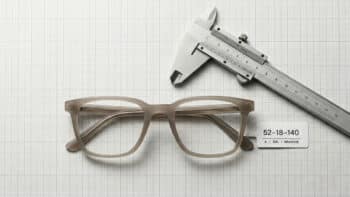
Eyewear is still mostly sorted into two buckets: “men” and “women.” In store displays, on racks, and inside e-commerce filters, that split looks obvious. But the question deserves a clean answer: are men’s vs women’s glasses separated by measurable, fit-driven differences—or mainly by retail segmentation and visual style codes? To answer without caricature, you have […]