
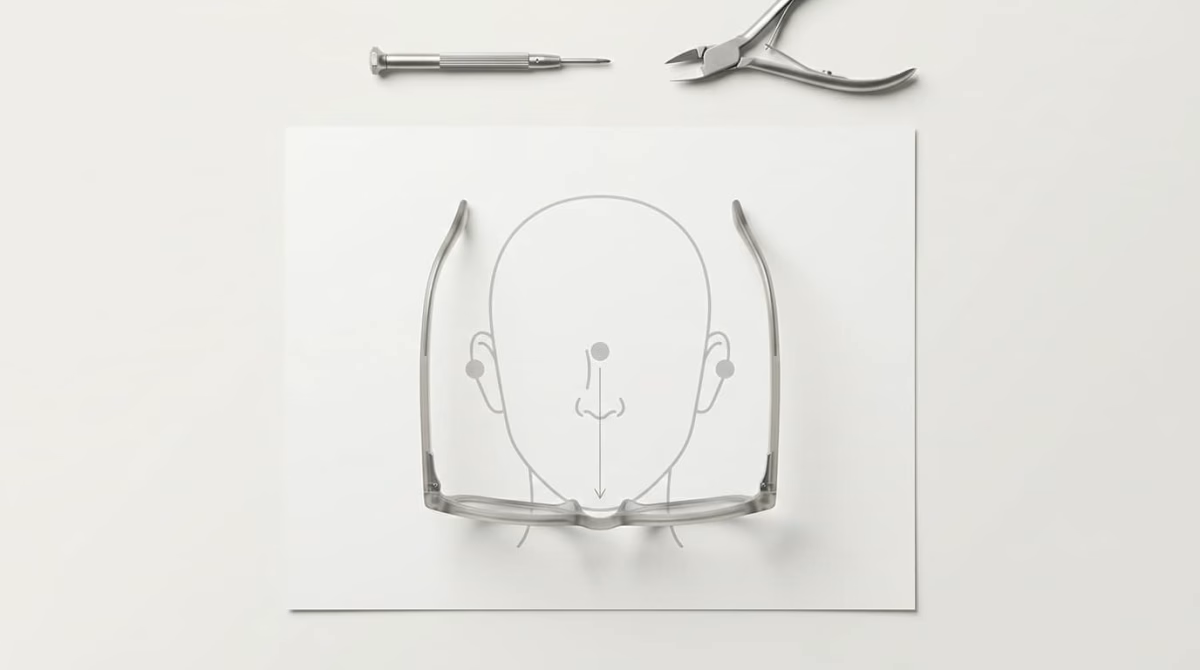
Glasses keep slipping is a simple symptom: you keep pushing the frame up, your eye line breaks, and a good-looking front becomes unusable. The cause is rarely “mysterious.” A frame stays put when its geometry creates a stable balance across three zones: nose support, retention behind the ears, and weight distribution between front and back.
This belongs to proportion-based eyewear. The same construction can work for very different faces when it exists in coherent widths, bridges, and temple geometries. Conversely, a stylish frame that’s out of proportion often becomes—mechanically—glasses that keep slipping.
Frame stability: three zones, one logic
1) Nose support (bridge / pads)
The nose doesn’t “stick” a frame in place. It stabilizes it only if the contact surface is correct: position, height, bridge shape (or nose pads), and left/right symmetry. When this zone is mismatched, the frame settles on a slope, creeps forward, then drops. Result: glasses keep slipping even indoors, without activity.
2) Retention behind the ears (temples)
Ears don’t carry the frame; they stop the front from pitching forward. For that, the temple must have the right effective length and a bend placed in the correct zone. If temples don’t retain, the nose becomes the only support point. Then slipping becomes automatic: gravity is enough.
3) Front/back balance (center of gravity)
A stable frame doesn’t need to clamp. It needs a controlled center of gravity. A front that’s too heavy, temples that are too light, too much temple spread, or a poor tilt angle can make the front “pull.” Glasses keep slipping often signals an overall balance issue more than a single defect.
Quick diagnosis: isolate the dominant cause in 6 tests
These tests help avoid the classic dead ends (“it’s my skin,” “it’s heat”) when the issue is structural.
- Test 1 — Head down: if the frame drops immediately, the front is often too wide or temples aren’t retaining.
- Test 2 — Smile / talk: if the frame shifts when you smile, bridge contact and/or front tilt is often involved.
- Test 3 — Nose mark: a mark that’s too high, too centered, or asymmetric points to inefficient or uneven support.
- Test 4 — One-sided slip: if it slips more on one side, suspect asymmetry (pads, temples, alignment).
- Test 5 — Temple spread: if temples flare easily, lateral support is usually weak.
- Test 6 — Ear “hook”: if the temple doesn’t naturally settle behind the ear, the effective length or bend placement is off.
At this stage you can usually tell whether the fix is adjustment—or a base proportion mismatch. Those are not solved the same way.
Main causes, ranked by proportions
1) Frame front too wide: the frame “floats”
A front that’s too wide creates a misleading feeling: instant comfort, no pressure… then glasses keep slipping. Lateral support is insufficient; the frame creeps forward, and the nose ends up carrying everything. Common signs: very open temples, shifting while walking, clear drop when you tilt your head down.
Realistic fix: this rarely becomes durable with “tweaks.” You usually need a narrower front width or a construction that provides coherent lateral support for your face width.
2) Bridge mismatch: contact too high, too flat, or poorly positioned
The bridge isn’t just a number. It’s contact geometry. If contact is too high or too flat, the frame sits on a slope and slowly descends. Glasses keep slipping even at rest, sometimes with a nose mark in the wrong spot.
Realistic fix: switch to a different bridge geometry (shape/height/contact) or to a frame with adjustable pads for finer control.
3) Nose pads misadjusted: it pinches, yet it drops
With adjustable pads, poor setup can create a paradox: discomfort and glasses keep slipping at the same time. Pads too open: not enough usable contact. Too closed: pressure without stability. Asymmetry: the frame tilts and “searches” for a new support point.
Realistic fix: symmetrical pad angle and spacing, then a full alignment check. This is balance tuning, not force.
4) Temples: wrong effective length or bend placement
The printed temple length doesn’t tell you where the bend lands. If the bend is too far back, the temple won’t retain. Too far forward, it pushes and can pitch the front down. Either way, glasses keep slipping, sometimes with irritation behind the ear.
Realistic fix: adjust bend placement and behind-ear contact; if temples are too short or the geometry can’t match your ear position, change temple length/shape.
5) Tilt / pitch: the front rotates forward
A frame can slide not because it’s too wide, but because it’s pitching forward on the nose. This is common when glasses keep slipping mostly while talking, smiling, or when the frame interacts with cheeks. The issue isn’t “grip”; it’s angle and rotation.
Realistic fix: verify front tilt and overall temple geometry (height, plane, symmetry). Small alignment changes can stop forward rotation.
6) Weight distribution: front-dominant balance
A frame can be light and unstable, or denser and very stable. What matters is distribution. A thick front paired with overly light temples can encourage glasses keep slipping: the front “pulls,” and the nose loses the fight. Durable stability comes from restoring balance: sufficiently structured temples, coherent bridge contact, correct angles.
What can be adjusted vs what must be chosen
To fix glasses keep slipping, separate two families of solutions.
What can be adjusted (when base proportions are right)
- Nose pad symmetry and angle.
- Full frame alignment (front sits level on the face).
- Temple bend and behind-ear contact.
- Temple spread (light, consistent lateral support).
What must be chosen (when base proportions are wrong)
- Front width matched to face width.
- Bridge geometry compatible with nose height/shape.
- Temple effective length that actually retains (not just the printed number).
- Balanced front/temple structure and overall weight distribution.
Common mistakes: treating the symptom instead of the cause
Two reflexes often make things worse:
- Over-tightening: pressure increases, comfort drops, and forward pitch can worsen. Glasses keep slipping returns with marks and tension.
- Patch fixes: sleeves, adhesives, grip pads. They can help short-term, but they hide the root cause (bridge/width/temples) and keep the frame out of balance.
Related analyses

The word “unisex” is everywhere in eyewear. It can refer to a style, an intention, or a way of classifying a collection. It can also conceal a less simple reality: no frame suits everyone. Faces vary in width, noses vary in height and shape, ears vary in position, and stability depends on wearing geometry. To […]

In many optical shops, the “Men” / “Women” split feels obvious. It reassures, guides, and speeds up decisions. Yet frame stability depends mostly on fit variables (overall width, bridge, temples) and design codes (shapes, volumes, color). So why does this sorting persist—even when collections claim to be unisex? The answer isn’t “marketing vs truth.” Separating […]

How to choose glasses for face width without guessing: face width is the most useful reference point. It drives stability (they stay put or they slide), alignment (the frame stays centered), and the visual outcome (proportions look balanced or forced). Style comes after: a shape can look perfect, but if width is out of tolerance, […]

Glasses size is often reduced to a string of numbers printed inside the temple. Yet those dimensions drive comfort, stability, and the visual balance of a frame. Understanding them lets you read eyewear as a set of proportions—not a marketing label. Lens width, bridge width, temple length: each value has a specific role. Before style, […]

Eyewear is still mostly sorted into two buckets: “men” and “women.” In store displays, on racks, and inside e-commerce filters, that split looks obvious. But the question deserves a clean answer: are men’s vs women’s glasses separated by measurable, fit-driven differences—or mainly by retail segmentation and visual style codes? To answer without caricature, you have […]
FAQ — Glasses Keep Slipping
Why do my glasses keep slipping even though they don’t feel tight?
Because a frame can feel comfortable and still be too wide or poorly balanced. Without lateral support and proper retention behind the ears, the nose becomes the only support point and the frame drops.
How can I tell if the bridge is the problem?
If glasses slip even at rest, or if the nose mark is too high, too centered, or asymmetric, nose support is likely inefficient. Bridge geometry (shape, height, position) becomes the first suspect.
Can nose pads cause slipping?
Yes. Pads that are too open lose effective contact, pads that are too closed create pressure without stability, and a small asymmetry can tilt the frame. This can produce slipping even when the frame feels “tight.”
Why do my glasses slip when I look down?
This often indicates a front that’s too wide or temples that don’t retain behind the ear. The frame creeps forward, then drops under gravity.
Should I tighten the temples to stop slipping?
Over-tightening is rarely durable. Too much pressure can increase forward pitch and discomfort. The goal is balance between nose support, behind-ear retention, and temple spread—not clamping.
When should I change frames instead of adjusting?
If alignment is correct and adjustments (pads, temples) are done properly but slipping persists, the base proportions are likely wrong: front width too large, bridge mismatch, or incompatible temples. A different geometry is needed.