

In many optical shops, the “Men” / “Women” split feels obvious. It reassures, guides, and speeds up decisions. Yet frame stability depends mostly on fit variables (overall width, bridge, temples) and design codes (shapes, volumes, color). So why does this sorting persist—even when collections claim to be unisex?
The answer isn’t “marketing vs truth.” Separating men’s vs women’s glasses in stores is first an organizing tool: it helps manage a broad assortment, reduces search effort, and structures merchandising. The problem is that an organizing tool can become a shortcut: it blends style, buying habits, and sometimes assumptions about morphology. That’s where confusion starts.
What the split really organizes: a legibility system
An optical store doesn’t display a single product. It displays a combination: frame + prescription + use cases + comfort + aesthetics. The wall has to help shoppers eliminate a large part of what won’t work—before they even get into fit details. The men’s vs women’s glasses in stores split acts as an initial filter: it structures the entry into the offer.
This filter isn’t necessarily ideological. It’s often a response to a simple constraint: too much choice kills choice. The store reduces visual noise and offers a navigation path that makes sense within seconds.
Three retail constraints that explain why the split persists
1) Assortment depth
Between shapes, materials, colors, sizes, brands, and price tiers, the assortment explodes quickly—and floor space is finite. “Men/Women” works like a family classification even if boundaries are porous. In that context, men’s vs women’s glasses in stores is less a truth about faces than a way to make the offer browsable.
2) Reducing uncertainty and speeding the first shortlist
The first problem is not “explore everything,” but “build a plausible shortlist fast.” Gender sorting acts as a navigation shortcut: it reduces the number of frames to consider, limits decision fatigue, and provides a starting point most people understand immediately.
In other words, men’s vs women’s glasses in stores works as an entry filter. It points shoppers toward silhouettes a portion of the public expects—before more discriminating criteria (width, bridge, temples, stability) take over.
3) Inventory and replenishment logic
A store thinks in turnover and risk: cash tied up in inventory, sizes that sell best, colors that linger. Categorizing men’s vs women’s glasses in stores can help steer the assortment: balancing “families,” avoiding visible duplication, and allocating purchasing budgets across styles and perceived customer segments.
Gender sorting often serves as a proxy—for style
In practice, “Men” and “Women” frequently describe sets of visual codes: thickness, sheen, angles, tints, detail density, contrast. Historically, certain shapes were offered more on one side than the other. That history is not a technical rule.
The result: men’s vs women’s glasses in stores mostly organizes aesthetic expectations. And as tastes shift (volume returns, oversize silhouettes, panto shapes, softened rectangles), the borders move. A common outcome is straightforward: a male shopper finds the best frame in the “Women” section, and vice versa—without it being a “hack.”
Morphology matters—but retail can’t encode it simply
The useful variable isn’t gender. It’s measurements: face width, nose shape and height, ear position, stability needs. Those parameters don’t display cleanly as universal signage. To stay readable, the store relies on fast categories.
Within that constraint, men’s vs women’s glasses in stores can act as an implicit morphology proxy—more wide faces clustered in one area, bridges perceived as “more suitable” for certain profiles, and so on. The issue: this proxy is neither reliable nor universal. It can help statistically while failing in many individual cases.
What actually decides the choice: size, bridge, temples
Look closely and another reality shows up: most selection problems come from size and fit, not the label on the wall. The decision usually turns on:
- Total frame width (too narrow: pressure; too wide: instability).
- Bridge (contact, height, position on the nose).
- Temples (effective length, curvature, retention behind the ear).
These variables are hard to merchandise intuitively. A size-sorted wall can be excellent—but it requires education and strict maintenance. The men’s vs women’s glasses in stores split is often chosen because it’s simpler to keep consistent day to day.
Men’s vs women’s glasses in stores: why the split is still “effective” for some shoppers
A pragmatic reason: many people walk in with a clear idea of what they want to avoid. “Men” or “Women” becomes a first filter, even if it’s not technically optimal. In-store, perceived efficiency matters: reduce discomfort, reduce hesitation, speed the conversation with the optician.
In that sense, men’s vs women’s glasses in stores becomes a shared language: imperfect, but operational. The risk begins when that language hardens and pretends to describe technical needs. A well-structured store keeps the split as a journey tool—without treating it as a fit rule.
The e-commerce case: filters and uncertainty reduction
Online, “Men/Women” has a direct function: reduce the number of products shown and provide a simple entry point. It also reduces uncertainty by placing the shopper in a “familiar universe.”
But a useful online store can’t stop there. It needs filters closer to reality: width, bridge, temple length, style, use case. That layer secures decisions far more than the “Men/Women” label. In that logic, men’s vs women’s glasses in stores (and online) is an entry point, not a complete method.
Alternatives to Men/Women sorting: what more structured stores do
Several classifications work without losing shoppers:
- By widths: narrow / medium / wide, with a stable, simple reference.
- By shapes: panto, round, softened rectangle, oversize, etc.
- By use cases: sun, screen, sport, everyday, prescription.
- By style universes: minimal, retro, contemporary, technical.
These approaches demand stronger offer editing: coherent sizing, bridge variety, and enough depth per family. They are more demanding, but they align store organization with what actually keeps a frame stable on the face.
How to read a store: 5 signals showing what the split “hides”
- Signal 1: Are multiple widths visible (narrow/medium/wide), or is everything mixed?
- Signal 2: Are bridges varied (shapes, heights), or mostly uniform?
- Signal 3: Does the store talk about stability, contact points, and retention—or only style?
- Signal 4: Does the store address adjustment (nose pads/temples) and on-face stability—or stop at appearance?
- Signal 5: Is gender sorting a doorway—or a boundary (you’re redirected to “your” section)?
These signals show whether men’s vs women’s glasses in stores is used as simple signage—or as a rule that replaces proportion-based fit reading.
Key takeaways
- The split serves legibility first: it organizes a large assortment and a selection path.
- In practice, it often classifies style codes more than technical needs.
- Fit depends on concrete variables (width, bridge, temples) rarely encoded explicitly in-store.
- A “Men/Women” wall can be useful as a filter—if it doesn’t become a boundary.
- The most robust setups add size and proportion cues, alongside or instead of gender sorting.
Related analyses
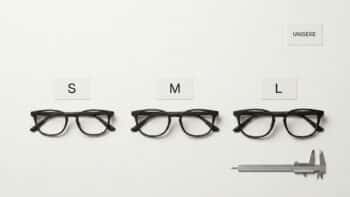
The word “unisex” is everywhere in eyewear. It can refer to a style, an intention, or a way of classifying a collection. It can also conceal a less simple reality: no frame suits everyone. Faces vary in width, noses vary in height and shape, ears vary in position, and stability depends on wearing geometry. To […]

Glasses keep slipping is a simple symptom: you keep pushing the frame up, your eye line breaks, and a good-looking front becomes unusable. The cause is rarely “mysterious.” A frame stays put when its geometry creates a stable balance across three zones: nose support, retention behind the ears, and weight distribution between front and back. […]
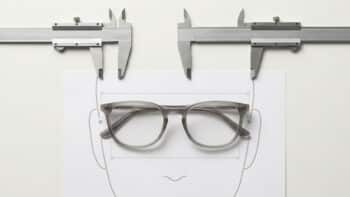
How to choose glasses for face width without guessing: face width is the most useful reference point. It drives stability (they stay put or they slide), alignment (the frame stays centered), and the visual outcome (proportions look balanced or forced). Style comes after: a shape can look perfect, but if width is out of tolerance, […]
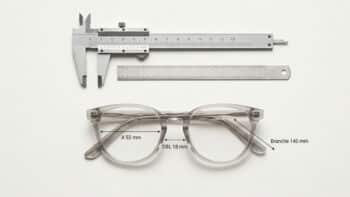
Glasses size is often reduced to a string of numbers printed inside the temple. Yet those dimensions drive comfort, stability, and the visual balance of a frame. Understanding them lets you read eyewear as a set of proportions—not a marketing label. Lens width, bridge width, temple length: each value has a specific role. Before style, […]
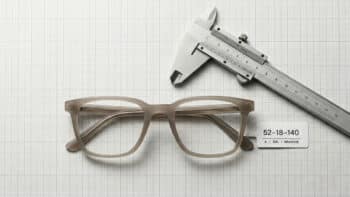
Eyewear is still mostly sorted into two buckets: “men” and “women.” In store displays, on racks, and inside e-commerce filters, that split looks obvious. But the question deserves a clean answer: are men’s vs women’s glasses separated by measurable, fit-driven differences—or mainly by retail segmentation and visual style codes? To answer without caricature, you have […]
FAQ — Men’s vs women’s glasses in stores
Why do stores still separate men’s and women’s glasses?
Because it improves navigation clarity and speeds up the first shortlist. It organizes a large assortment and a selection path, even if it isn’t a technical fit method.
Does that separation reflect real morphology differences?
Not reliably. The variables that matter for stability are individual measurements (frame width, bridge, temples). Gender sorting can act as a proxy sometimes, but it doesn’t replace proportion-based fit reading.
If a “women’s” frame fits me better, is that a problem?
No. The wall label often reflects style codes and store organization. The right frame is the one that stays stable and matches your proportions, regardless of section.
How can a store classify frames without gender sorting?
Common alternatives are sorting by widths (narrow/medium/wide), by shapes, or by use cases. These require coherent sizing and simple education.
Is men/women sorting different online?
Online it mainly reduces the number of products shown and gives an easy entry point. More useful sites add reality-based filters: width, bridge, temple length, and style.
What’s the best in-store reference to ask for to avoid a bad choice?
A width reference (narrow/medium/wide) and an on-face stability check: nose contact, retention behind the ear, and stability when you tilt your head.