
The word “unisex” is everywhere in eyewear. It can refer to a style, an intention, or a way of classifying a collection. It can also conceal a less simple reality: no frame suits everyone. Faces vary in width, noses vary in height and shape, ears vary in position, and stability depends on wearing geometry.
To understand what unisex eyewear really means, three levels need to be separated: aesthetic codes, size architecture (proportions), and commercial organization (retail and e-commerce). Unisex is only credible when these three levels stay aligned: clear language, explicit sizing, and navigation that does not force the customer to guess.
Unisex: One Word, Two Realities
1) Unisex as a style code
In its most common use, “unisex” means: a shape wearable by a broad audience, less gender-coded visual cues, less assigned colors, and volumes assumed to work across categories. This is a cultural reading. It can be relevant, because style does not reduce itself to fixed categories, and silhouettes move from one wardrobe to another.
But this definition is limited: it speaks about image, not fit. A frame may be highly “unisex” in intention and still fail in wear if the face width, bridge, or temples do not match. When speaking about unisex eyewear in a durable sense, style alone is not enough.
2) Unisex as an architecture of proportions
The other reality is more structural: the construction is designed to be worn by varied morphologies, through size grading and through bridge and temple geometries that cover real diversity. Here, “unisex” does not describe “everyone,” but a family of frames designed around measurable parameters.
This is where eyewear shifts: categories become less like labels and more like fit markers. In that logic, unisex eyewear does not replace sizes; it makes sizes central.
Why unisex appears as a trend
The first driver is cultural: gender codes in accessories have loosened. Consumers are buying more by silhouette, volume, and aesthetic intention. The second driver is editorial: a brand would rather tell one cross-category story than build two separate worlds.
The third driver is commercial: “unisex” simplifies the message. A collection can be presented as one coherent set, without duplicating similar shapes into two departments. For part of the audience, the promise is easy to read: fewer barriers, more freedom of choice.
But a trend is not a structure. A unisex frame that exists in only one width, one bridge, and one temple length is not a solution: it is one shape placed onto a variable reality.
What really changes when unisex becomes structural
1) The center of gravity shifts from “gender” to measurement
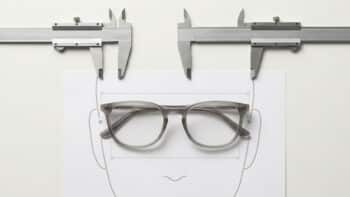
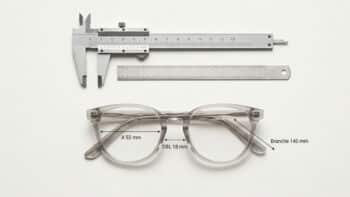
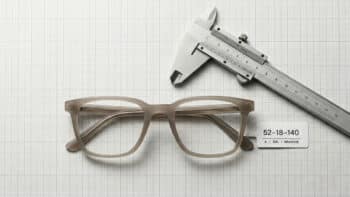
When an offer becomes truly cross-category, it relies on frame measurements and wearing geometry. The core references are well known: lens width (A), bridge (DBL), temple length, and, when the information is well presented, total frame width and lens height. These values do not speak about gender; they speak about proportions.
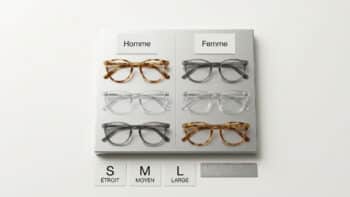
A coherent unisex eyewear collection accepts that logic: it offers size ranges (for example narrow/regular/wide or S/M/L) and makes those markers visible, instead of leaving them hidden inside the temple.
2) Size grading becomes an editorial decision
Offering unisex in a credible way raises a range question: how many widths per shape? How many genuinely different bridges? Which temple lengths? The answer depends on positioning, but the mechanism is stable: without grading, part of the audience is forced to “tolerate” a frame instead of actually wearing it well.
This is where a shift appears: some brands build one silhouette (panto, softened rectangle, round, oversized) and then release it in two or three widths, instead of duplicating the silhouette into “men” and “women.” This movement makes unisex eyewear stronger, because it turns a label into an architecture.
3) The bridge becomes a major axis, not a detail
Many fit failures come from the bridge: support too high, surface too flat, interaction with the cheekbones, slipping. A serious unisex offer includes bridge geometries, not just numbers. That is the idea behind approaches such as “low bridge fit”: responding to lower nose bridges, higher cheekbones, or a different support zone, independently of any style label.
In other words, unisex eyewear only becomes robust when it admits that the nose is a design parameter, not a fitting afterthought.
4) Adjustability becomes a product value again
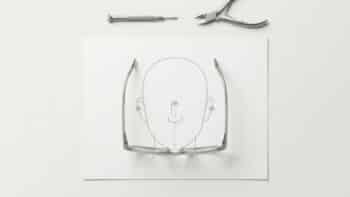
Another structural marker is tolerance: the frame’s ability to be adjusted without weakening how it wears. Metal bridges with adjustable nose pads, temples that can actually be shaped, controlled opening, coherent hinges: these elements are not “gendered.” They determine whether one geometry can absorb individual variation.
A unisex eyewear collection gains credibility when it favors adjustable, stable construction rather than a single “universal” shape.
What does not change: unisex does not erase facial diversity
The classic trap is to confuse cross-category design with uniformity. Faces overlap widely: very different profiles can wear the same shape. But that overlap does not imply one single size. It implies a grid of proportions. Once that is forgotten, “unisex” is reduced to a word that protects neither comfort, nor stability, nor aesthetic coherence in wear.
In a rigorous reading, unisex eyewear is not a promise of total compatibility. It is a promise of consistent construction, offered in sizes and in bridge and temple geometries that cover real diversity.
Retail and e-commerce: unisex changes navigation, not just the message
In stores, the “Men/Women” split has often served as a readability filter. As unisex grows, the question becomes: what should replace that filter without making the assortment harder to read? The most useful organizations add simple markers: narrow/medium/wide, shapes, uses, universes. These are categories that speak to customers while remaining compatible with measurement.
In e-commerce, the issue is even clearer: if “unisex” becomes a main filter, it must be accompanied by actionable information. Without face width, bridge, or temple length, the customer is browsing on intuition. By contrast, a store that truly follows a unisex eyewear logic provides proportion-based filters (narrow/regular/wide, S/M/L, low bridge, temple lengths) and makes the decision more rational, and therefore more stable.
Credible unisex: three simple criteria
- Sizes: at least two widths per family, or one clear grid (S/M/L, narrow/regular/wide) supported by readable measurements.
- Coherent bridges: geometries that make sense, including lower bridge options when needed.
- Usable information: visible measurements and proportion-based filters, both in-store and online.
When these three criteria are met, unisex eyewear stops being an aesthetic label. It becomes a structural shift: eyewear organized by proportions, where construction stays consistent and size becomes a language again.
Key takeaways
- “Unisex” can describe a style, but it becomes durable when it is built on a size architecture.
- Cross-category design does not mean “one size fits all”: it requires grading in width, bridge, and temples.
- Bridges and adjustability are structural levers, independent from gender codes.
- In e-commerce, unisex is only useful when paired with proportion-based filters and visible measurements.