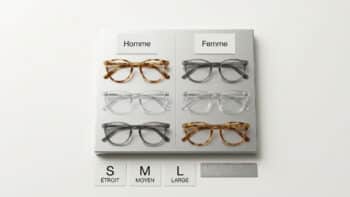

Eyewear is still mostly sorted into two buckets: “men” and “women.” In store displays, on racks, and inside e-commerce filters, that split looks obvious. But the question deserves a clean answer: are men’s vs women’s glasses separated by measurable, fit-driven differences—or mainly by retail segmentation and visual style codes?
To answer without caricature, you have to separate three layers that get mixed up: fit (what can be measured and adjusted), design (what is visually coded), and market organization (how stores and brands benefit from classification). Once those layers are separated, the “men/women” distinction becomes clearer: some statistical tendencies exist, but individual overlap is dominant—and the label is not a technical criterion.
1) Technical sizing standards: gender-neutral measurements
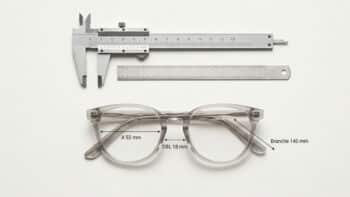
A frame is defined first by dimensions. The most familiar numbers are printed inside the temple as a triplet like 52-18-140. They refer to:
- A: lens width (e.g., 52 mm).
- DBL: bridge width / distance between lenses (e.g., 18 mm).
- Temple length: temple/arm length (e.g., 140 mm).
These measurements do not mention gender. They describe geometry. In real-world wear, two additional factors often control comfort and stability but are rarely displayed: true total frame width (the actual outer-to-outer width of the front) and bridge geometry (shape, height, contact surface, and where the load sits on the nose).
Direct consequence: if you look for a strictly “technical” justification for a men/women split, you won’t find it in the language of sizing. Standards describe dimensions that can work for anyone; what varies is the offer—what sizes are produced, and how those sizes are presented and filtered.
2) Morphology: average tendencies, dominant overlap
Craniofacial anthropometry research shows average variations between groups (sex, age, geographic ancestry, and more). Mean differences can appear in face width, some nasal proportions, or how the nose relates to cheekbones. But the distributions overlap heavily: the range of individual values intermixes.
Plainly: two people of different sexes can share very similar measurements; two people of the same sex can be far apart. That is why a men/women eyewear split cannot map onto “two distinct morphologies.” At best, it bundles tendencies and supply habits; at worst, it replaces proportion-reading with a convenient label.
This point matters: morphology is not a single marker. Face width, nose height, ear position, and cheekbone shape interact. Fit is decided case by case—even when you acknowledge statistical tendencies.
3) Fit: what makes a frame stay put (regardless of the aisle)
Fit is the real on-face outcome: comfort, stability, optical centering, and balance. In most cases, success or failure concentrates in three zones:
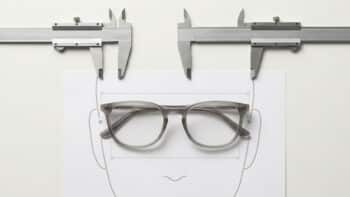
Front width
A frame that’s too wide lacks lateral support: it creeps forward and can slide. A frame that’s too narrow compresses, leaves marks, and sits out of alignment. This single factor explains a large share of “it won’t stay” or “it pinches” complaints that are wrongly attributed to a men/women category.
Bridge and nose contact
The bridge is not only a number (DBL). It’s a contact geometry: height, contact surface, angle, and how it interacts with the nose—and sometimes the cheekbones. A frame can have a “correct” DBL and still be unstable if the contact is too high, too flat, or poorly distributed. Conversely, a slightly wider frame can feel locked-in if the bridge geometry matches.
Temples and retention behind the ear
Temple length alone is not decisive. The bend position, temple spread, symmetry, and overall alignment matter. Too little retention turns the nose into the only support point; too much retention creates pressure without durable stability.
A practical rule follows: if you want to explain men’s vs women’s glasses in technical terms, you talk about width, bridge geometry, and temples—not labels. A label guarantees neither stability, nor comfort, nor centering.
4) Design: what “men” and “women” usually classify
If measurements are neutral, why does the split feel so “real”? Because design encodes expectations. Across many collections, certain choice families repeat:
- Shapes: sharper angles vs softer curves; softened rectangles, panto, ovals, cat-eye.
- Volume: thickness, relief, bevels, and front visual density.
- Colors and finishes: muted vs high-contrast palettes; matte/gloss; transparency.
- Details: temple signatures, metal parts, decorative elements, prominent logos.
These are codes. They support men/women segmentation because they make an “universe” instantly recognizable. But they are not biomechanical constraints. A frame coded as “women’s” can be technically excellent on a face marketed as “men’s,” and vice versa. Style classifies intention; fit classifies compatibility.
5) Retail and industry: why the split persists
In stores, classification primarily serves clarity. Assortments are large, attention is limited, and layout must enable a fast first pass. The men/women split works as an entry-level filter that is often closer to style than to morphology.
From an industry standpoint, the split also helps: it structures product lines, organizes seasonal releases, and simplifies buying decisions (families, colors, volume profiles). But it has a side effect: it can suggest a technical necessity, when it mostly describes market organization.
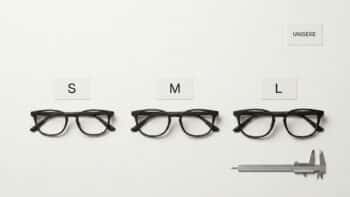
Online, the mechanism is even clearer: “men/women” reduces what appears on screen and reassures the shopper. It is an effective first filter—but not a fit method. Without proportion cues (true front width, bridge geometry, temple behavior, usable size grids like S/M/L), people shop by visual signal instead of actionable criteria. That’s where confusion sets in: measurement is replaced by a style universe.
6) “Unisex”: useful only when it’s built on sizing
So-called “unisex” lines are growing. That shift can stay superficial (a styling label) or become structural (a range architecture). It becomes credible when it puts upfront what segmentation tends to hide: sizes and proportions.
A rigorous unisex approach does not claim “one frame fits everyone.” It says: one construction, offered in sizes; visible measurements; coherent bridge options; temple behavior that can be adjusted; information you can use to choose. In that model, gender stops being a mandatory entry key. It becomes one cultural reference among others—not a substitute for dimensions.
What the label explains—and what it doesn’t
Men’s vs women’s glasses are not separated by radically different technical construction. Measurement standards (A, DBL, temple length), true front width, bridge geometry, and on-face balance remain the determinants of fit. The category mainly organizes style universes and commercial navigation.
The most useful reading is therefore double: accept that the market classifies to keep the offer legible, while choosing frames by measurable proportions. Separating what is measured from what is coded is how you exit false debates and end up with the simple outcome that matters: a frame that stays put and sits right.