
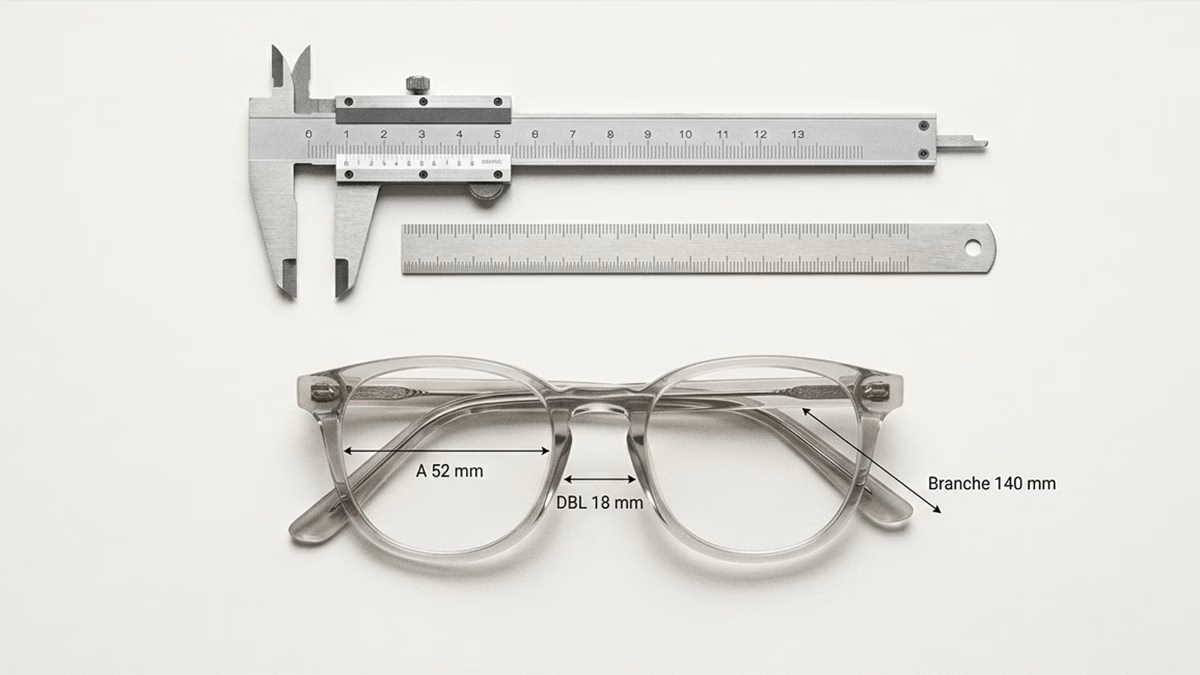
Glasses size is often reduced to a string of numbers printed inside the temple. Yet those dimensions drive comfort, stability, and the visual balance of a frame. Understanding them lets you read eyewear as a set of proportions—not a marketing label.
Lens width, bridge width, temple length: each value has a specific role. Before style, size is the technical base of fit.
Why glasses size matters
A frame that’s too wide tends to slide and loses lateral support. Too narrow, it creates pressure at the temples and can sit out of alignment. Glasses size directly affects fit and optical centering.
Proportions also influence how the frame sits: height on the nose, pantoscopic tilt, and lens-to-eye distance.
Understanding A, DBL, and temple length
The standard system used by manufacturers relies on three main measurements:
- A: lens width
- DBL: distance between lenses (bridge width)
- Temple length
What does 52-18-140 mean?
52 mm is the lens width (A), 18 mm is the bridge width (DBL), and 140 mm is the temple length. Together, these numbers describe the frame’s baseline geometry.
That’s why glasses size is an objective reading of dimensions, independent of gendered retail categories.
S/M/L, XL, and “oversized”: how to interpret size labels
Some brands translate glasses size into S, M, L, or XL. These letters can help you scan quickly, but they are not a universal standard.
S/M/L: a brand-specific shortcut
An “M” in one brand can match an “S” or “L” elsewhere. Millimeters remain the reliable reference.
XL: mostly about width
An “XL” frame usually targets a wider front and sometimes longer temples. The key is consistency between face width and the frame’s true front width.
Oversized: a style before it’s a size
“Oversized” mostly signals an aesthetic intent: taller lenses, stronger volume, more presence. A frame can look oversized without being very wide—and a wide frame can look restrained depending on lens height and shape.
Face width and proportions
In practice, three broad fit groupings are often used:
- Narrow face
- Medium face
- Wide face
Matching glasses size to real face width is one of the most direct ways to gain stability and comfort.
The bridge matters more than the DBL number
A bridge that’s too wide tends to encourage sliding; too narrow can create pressure. Adjustable nose pads (when present) can help adapt a frame to different noses, but the bridge is not just DBL: the shape, contact height, and surface area determine how the load sits on the nose.
Temple length and retention
Temples provide stability behind the ear. Common adult lengths often range from 135 to 145 mm, but length alone isn’t enough: where the bend starts, how the temples open, and overall alignment strongly affect retention.
Glasses size vs men’s/women’s segmentation
A, DBL, and temple length overlap widely across “men’s” and “women’s” collections. Most differences come from design coding (shape, volume, color, details), not from a separate technical sizing system.
How to choose the right glasses size
- Compare measurements with a frame that already feels comfortable.
- Check the frame’s true front width (not always shown online).
- Evaluate bridge contact (where it sits and how it supports).
- Confirm temple length and retention behind the ear.
Indicative ranges based on face width
Glasses size can be estimated from face width. The ranges below are indicative and can shift depending on frame shape and lens height.
Narrow face
- Lens width (A): ~46–49 mm
- Bridge (DBL): ~14–18 mm
- True front width: generally under ~130 mm
- Temples: ~135–140 mm
A frame that’s too wide may extend past the temples and lose stability.
Medium face
- Lens width (A): ~49–52 mm
- Bridge (DBL): ~16–20 mm
- True front width: ~130–138 mm
- Temples: ~140 mm
This grouping covers a large share of adult faces.
Wide face
- Lens width (A): ~52–56 mm
- Bridge (DBL): ~18–22 mm
- True front width: over ~138 mm
- Temples: ~145 mm and up
A suitable frame should match face width without lateral compression.
Important
Bridge shape, lens height, and face-wrap (curvature) also change comfort. Glasses size should be read as a set of proportions—not a single number.
Conclusion
Glasses size is the foundation of frame balance. Reading measurements lets you choose with precision, beyond categories and trend labels.


