
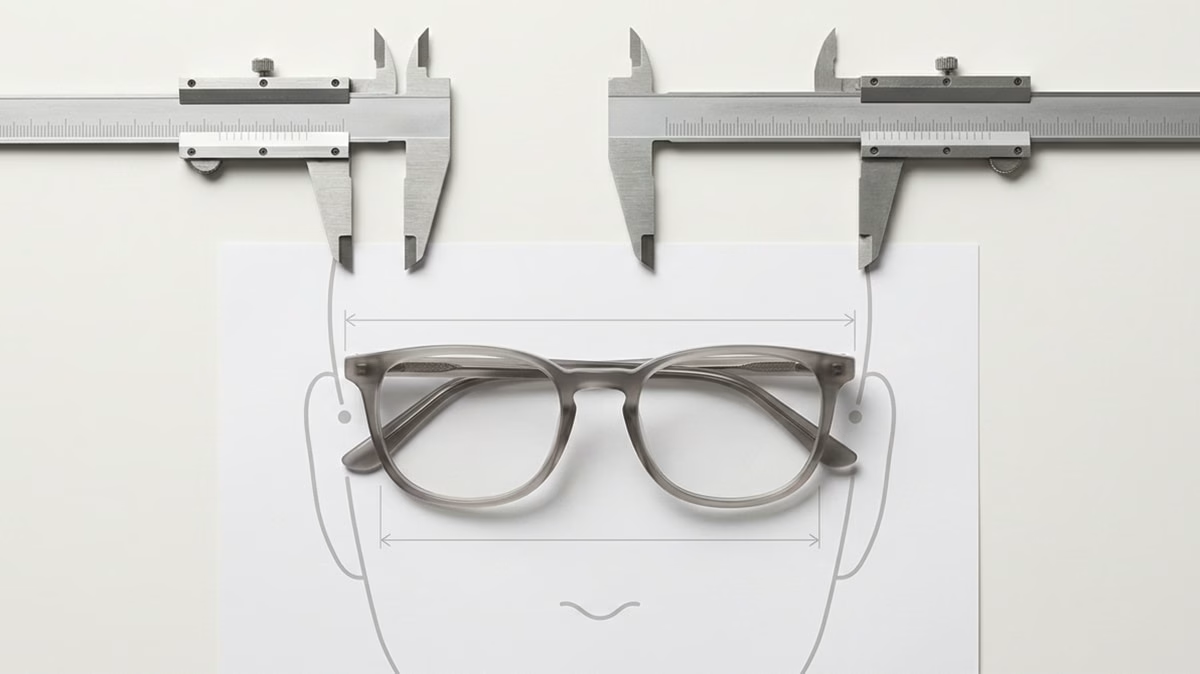
How to choose glasses for face width without guessing: face width is the most useful reference point. It drives stability (they stay put or they slide), alignment (the frame stays centered), and the visual outcome (proportions look balanced or forced). Style comes after: a shape can look perfect, but if width is out of tolerance, the frame won’t feel stable or look right.
The main trap is a common misunderstanding: people confuse the printed numbers (like 52-18-140) with real on-face width. A–DBL–temple length helps you compare frames, but front width (the true total width of the frame front) is the parameter that makes or breaks balance on the face. The goal here is simple: a repeatable method to choose glasses from face width—without relying on labels or intuition.
Why face width is the best starting point
Face width plays three roles at once:
- Hold: if the front is too wide, the frame lacks lateral support and creeps forward; if it’s too narrow, it pinches and throws alignment off.
- Centering: coherent width helps keep lenses and bridge on axis, reducing side-to-side drift.
- Proportions: the frame “frames” the face. Wrong width changes how the face reads (too small: the face spills past the frame; too wide: the frame dominates).
Width is not a detail. It’s the structure. Once that structure is right, shape becomes much more flexible.
Step 1 — Identify your usable face width (no tools)
To choose reliably, you need a stable reference. The simplest is the temple area: the widest points of the face, roughly at eye level.
Method A: mirror check (fast)
- Look straight ahead, head level.
- Locate the widest points around the temples.
- Use that line to judge a frame’s front width: ideally the frame front lands close to that boundary, without clearly extending past it or sitting notably inside it.
Method B: use a frame that already fits (most reliable)
If you own a pair that fits well, it becomes your benchmark. To choose faster, compare every new frame to it:
- Measure the true front width (outer edge to outer edge across the frame front) with a ruler.
- Note the A–DBL–temple numbers too—not to replace front width, but to understand what changed (wider lenses, narrower bridge, etc.).
This avoids the classic mistake: treating “52” as frame width when it’s lens width.
Step 2 — What the numbers tell you… and what they don’t
Many people try to choose from 52-18-140 alone. Useful, but incomplete.
A (lens width)
As A increases, the lens gets wider. But two frames with the same A can have different total front widths (hinge placement, front thickness, shape, bridge position).
DBL (bridge width)
DBL influences nose support and where the frame sits on the face. A larger DBL does not automatically mean “wider on the face”; it can mainly change placement and perceived balance.
Temple length
It describes length, not retention. A temple can be “the right length” and still fail if the bend starts too early or too late.
Operational takeaway: if you’re choosing based on face width, look first for true front width (when provided). Use A–DBL–temples to refine and compare.
Step 3 — Four width rules that prevent most mistakes
Rule 1: the frame should follow the face, not overshoot it
A well-proportioned frame front lands close to temple width. If it extends clearly past it, the frame tends to dominate and often loses lateral stability. If it sits clearly inside it, it compresses and visually “shrinks” the face.
Rule 2: the eye should stay centered in the lens
Too narrow: the eye drifts toward the outer lens edge. Too wide: the eye looks pulled inward. This is a visual check, but it’s highly effective: it confirms width is serving the face rather than forcing it.
Rule 3: the hinge should not crash into the temple
If the hinge sits too far inward toward the temple, the frame is often too narrow. It can leave marks and spread over time. If the hinge sits too far out (very wide front), temples leave at an angle that often increases instability.
Rule 4: stability is light lateral support, not compression
Correct width feels discreet: the frame doesn’t move when you turn your head, without squeezing. If you need to tighten the frame to make it stable, you’re compensating for a base proportion mismatch.
Step 4 — Confirm width with bridge + temples
Front width sets direction, but two zones finalize the decision: bridge contact (support) and temples (retention). All three must work together.
Bridge: consistent nose support
- If the frame drops easily, bridge contact is often mismatched (shape/height/contact area).
- If it leaves strong marks or pinches, support is too concentrated or poorly distributed.
- If you’re torn between two widths, better bridge geometry can make a slightly wider frame feel locked-in—or the reverse.
Temples: retention and balance
- A slightly wide frame can hold if temples retain properly behind the ear without forcing.
- A slightly narrow frame can become unwearable if temples compress, even when the front “looks” acceptable.
In practice: validate a width that positions the front correctly, then confirm bridge + temples stabilize without pain.
The “oversized” case: when it’s a choice, not a mistake
Oversized doesn’t mean “too big.” It’s a silhouette choice that can remain compatible with correct proportions. To go oversized without losing stability:
- Accept a visibly wider front, but keep a stable bridge contact.
- Avoid “floating oversized”: if the frame creeps forward and drops, the effect is accidental, not intentional.
- Watch temple angle: excessive flare often signals a front that’s too wide for your face.
Online: a fast method when you can’t try on
The most reliable e-commerce strategy is comparative:
- Start from a pair that fits well (or your target front width).
- Compare true front width if provided; otherwise compare A–DBL–temples plus the overall shape.
- Avoid changing multiple variables at once: if you go wider, keep bridge close; if you change bridge, keep width close.
The more stable your reference, the more mechanical—and reliable—your choice becomes.
Common mistakes (and how to fix them)
- Choosing by “men/women”: useful for navigation, but it doesn’t guarantee width or bridge fit.
- Confusing A with frame width: A is lens width, not total front width.
- Ignoring bridge geometry: correct width can still fail if nose support is wrong.
- Fixing a width mismatch by tightening: short-term workaround, discomfort and instability over time.
Final checklist: 7 points to validate
- The frame front lands close to temple width.
- Eyes stay centered in the lenses.
- The hinge doesn’t press into the temple.
- The frame doesn’t move when turning the head (light support).
- Bridge support is stable (no quick slipping, contact is distributed).
- Temples retain behind the ear without excessive pressure.
- Style intent (classic / oversized) is controlled, not compensating for poor fit.
In this series

The word “unisex” is everywhere in eyewear. It can refer to a style, an intention, or a way of classifying a collection. It can also conceal a less simple reality: no frame suits everyone. Faces vary in width, noses vary in height and shape, ears vary in position, and stability depends on wearing geometry. To […]

In many optical shops, the “Men” / “Women” split feels obvious. It reassures, guides, and speeds up decisions. Yet frame stability depends mostly on fit variables (overall width, bridge, temples) and design codes (shapes, volumes, color). So why does this sorting persist—even when collections claim to be unisex? The answer isn’t “marketing vs truth.” Separating […]

Glasses keep slipping is a simple symptom: you keep pushing the frame up, your eye line breaks, and a good-looking front becomes unusable. The cause is rarely “mysterious.” A frame stays put when its geometry creates a stable balance across three zones: nose support, retention behind the ears, and weight distribution between front and back. […]

Glasses size is often reduced to a string of numbers printed inside the temple. Yet those dimensions drive comfort, stability, and the visual balance of a frame. Understanding them lets you read eyewear as a set of proportions—not a marketing label. Lens width, bridge width, temple length: each value has a specific role. Before style, […]

Eyewear is still mostly sorted into two buckets: “men” and “women.” In store displays, on racks, and inside e-commerce filters, that split looks obvious. But the question deserves a clean answer: are men’s vs women’s glasses separated by measurable, fit-driven differences—or mainly by retail segmentation and visual style codes? To answer without caricature, you have […]
FAQ — How to choose glasses for face width
Why is face width the most important factor when choosing glasses?
Because it drives stability and proportions. Too wide: weak lateral support and frequent shifting. Too narrow: pressure and misalignment. Correct width makes shape selection much easier.
Are 52-18-140 numbers enough to choose a frame?
No. They describe lens width (A), bridge width (DBL), and temple length, but not the frame’s true front width. For face width matching, front width is the most direct indicator when available.
How can I tell if a frame is too wide?
Common signs: temples splay outward, the frame creeps forward and drops, frequent need to recenter. Visually, the front clearly extends past the temples and the eyes look pulled inward.
How can I tell if a frame is too narrow?
Common signs: pressure at the temples, marks, a “pushing” feeling. Visually, eyes sit close to the outer lens edge and the hinge looks pushed inward.
Is oversized compatible with correct face width?
Yes—when it’s controlled: stable bridge contact, proper temple retention, and no forward creep or slipping. Oversized should not mean a floating, unstable frame.
What’s the best method to choose glasses online?
Compare to a frame that already fits well. Use true front width if it’s provided; otherwise compare A–DBL–temples and avoid changing width, bridge, and temples all at once.