Thirty years after their debut, Oakley Jackets are no longer just evolving. They are redefining what sports eyewear can be — and what it represents.
In 1994, Oakley introduced a frame that didn’t exist before. Wraparound, bold, engineered not to please but to perform. In 2026, that same mindset expands into a broader vision: a complete ecosystem where eyewear, apparel, and industrial design merge into a single language.
1994: The anomaly that became a reference
It all started with a refusal — to design sports eyewear like everyone else.
The Eye Jacket, released in 1994, immediately broke conventions: dual-lens design, wraparound frame, anatomical fit. No compromise between protection and style — the two became inseparable. The Racing Jacket (1998) and Straight Jacket (1999) followed, each pushing further the idea that eyewear could be both a performance tool and a design object.
Within a decade, Oakley wasn’t just producing accessories. It was shaping cultural markers.
Artifacts from the Future: the 2026 vision
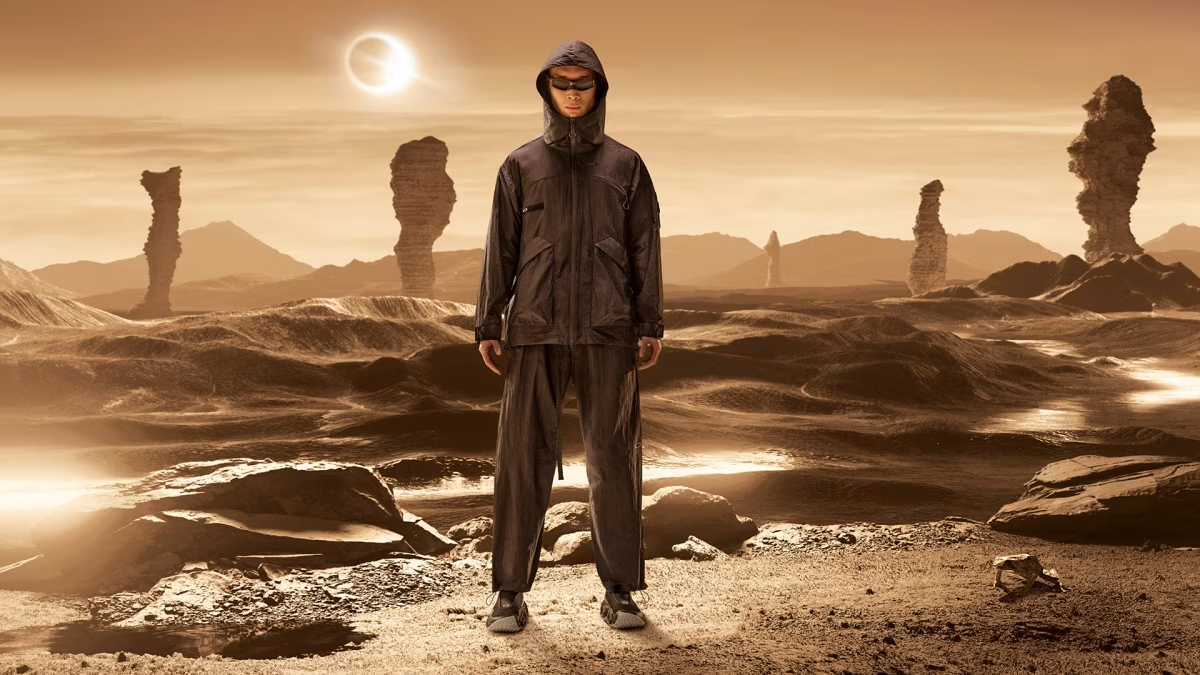
The 2026 collection is built around a strong concept: Artifacts from the Future. The idea is simple — create objects today that feel like they come from an already functional future: more technical, more structured, more defined.
This isn’t aesthetic speculation. It’s a method:
- anticipate usage;
- push form further;
- reject the obvious.
The Oakley Jackets 2026 embody this approach.
New models: one family, distinct identities
Plantaris SQ — structured expression
A squared evolution of the original Jacket DNA, delivering a more architectural presence while maintaining performance.
Neoforma — motion as a language
Kinetic design, forward-driven lines. Built to move — and to show it.
Terraforma — controlled impact
A universal silhouette with immediate recognition. Balancing accessibility and futuristic design.
Suture Jacket — defensive design
Launching April 2026, it pushes the concept further with sharper lines and protective volumes — closer to a structural shield than traditional eyewear.
Eye Jacket Redux — revisiting the origin
Reintroduced in 2019, it remains a benchmark. A design that still holds relevance today.
Prescription eyewear: expanding the system
With Neoture and Neomata, Oakley Jackets extend into everyday use. Same visual identity, same technical standards — adapted for prescription lenses.
This isn’t a compromise. It’s a natural extension: performance aesthetics entering daily life without losing intensity.
Japan Field Gear Line: from product to system
Oakley Jackets are no longer standalone objects. They integrate into a broader ecosystem: the Japan Field Gear Line, designed to interact directly with them.
FGL Stealth Line — function without visibility
Minimal design, technical materials, maximum efficiency without visual noise.
- FGL Stealth Jacket
- FGL Stealth Tee
- FGL Stealth Pant
For demanding conditions
- FGL AP Vest: equipment transport and protection
- FGL Slick Crew & FGL Factor Shorts: thermal regulation
Combined with Jackets — Neoforma, Plantaris SQ, Eye Jacket Redux — these pieces form a cohesive system. Not a look. A structure.
Why Oakley Jackets remain a reference in 2026
Sports eyewear is everywhere. True references are rare.
- ability to move between sport, design, and fashion
- consistency between form and function
- continuous lead over trends
In 2026, Oakley Jackets don’t follow trends. They continue to shape them.
Summary
Plantaris SQ
Positioning: Structured, geometric
Availability: Available
Neoforma
Positioning: Dynamic, kinetic
Availability: Available
Terraforma
Positioning: Futuristic, universal
Availability: Available
Suture Jacket
Positioning: Assertive, defensive
Availability: April 2026
Eye Jacket Redux
Positioning: Heritage, iconic
Availability: Available
Neoture / Neomata
Positioning: Prescription, everyday
Availability: Available
The Oakley Jackets 2026 mark a shift rather than a launch. They reinforce a core idea established in 1994: performance and aesthetics are not opposites — they enhance each other.
With the Japan Field Gear Line, that vision becomes a complete system. The object becomes interface. The product becomes language.