
On June 23, 2026, Meta and EssilorLuxottica unveiled Meta Glasses, a new line of smart eyewear. After Ray-Ban Meta and Oakley Meta, it is the first time the wearable carries Meta's own name — a sign that connected eyewear is establishing itself as a standalone optical category rather than a piece of technology grafted onto a heritage house. Priced from $299, prescription-compatible and offered in 26 styles, Meta Glasses is squarely aimed at everyday wear for the many.
A dedicated brand, beyond Ray-Ban and Oakley
EssilorLuxottica already owns Ray-Ban and Oakley, two houses that have served as vehicles for Meta's technology. Meta Glasses shifts the logic: the line no longer borrows a heritage name but introduces a brand conceived around AI from the outset. The group — already pursuing a custom-component strategy with Chips-IT — doubles down on connected optics, building on what Meta calls the world's best-selling AI glasses.
Three frames, a grammar of shapes
Meta Glasses revolves around three silhouettes designed for different faces and registers.
Meta Adventurer
A clean rectangle, timeless and versatile, available in Standard and Large.
Meta Fury
A bolder, more assertive shape that owns its statement.
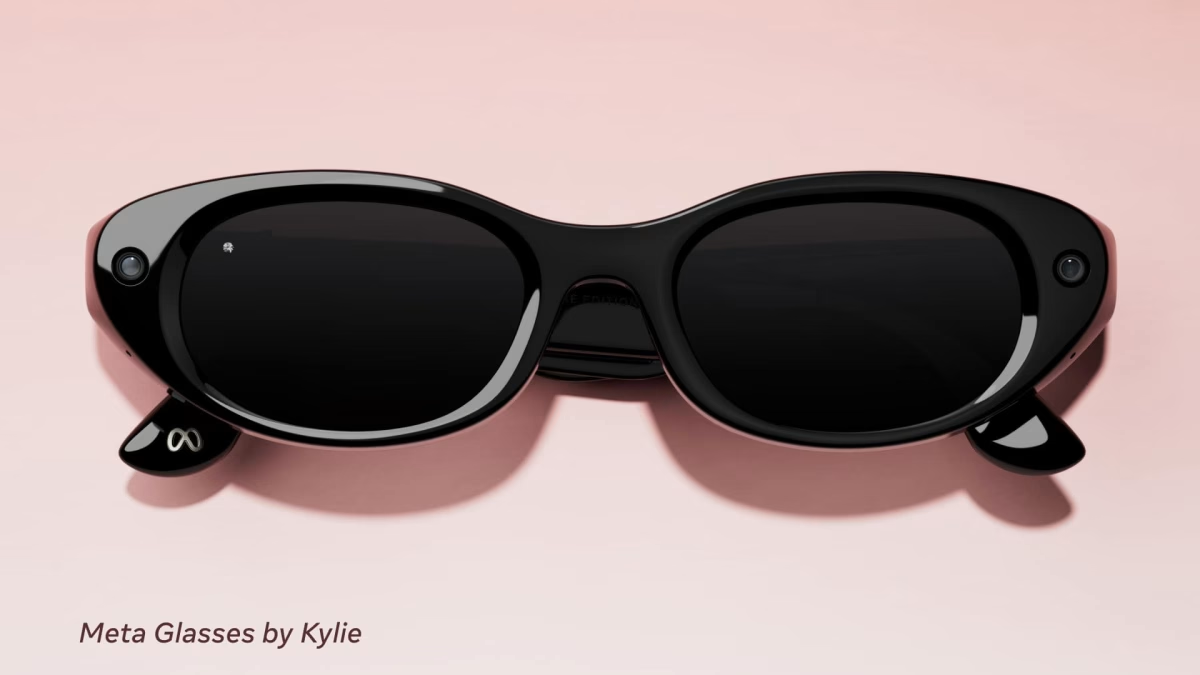
Meta Glasses by Kylie
A slim, narrow oval designed in collaboration with Kylie Jenner and inspired by her personal style.
In all, 26 styles combine colors, lenses and materials, all compatible with prescription lenses. Three-way adjustable nose pads fine-tune the fit — an optician's detail more than a gadget's, betraying the ambition to keep these frames on all day.
Muse Spark, the real generational leap
The most defining novelty is not the shape but the brain. Meta Glasses is the first pair to ship from day one with Meta AI powered by Muse Spark, the first model out of Meta Superintelligence Labs. The same engine is now reaching Ray-Ban Meta and Oakley Meta via update in the US and Canada. Sharper answers, a better grasp of what you are looking at, hands-free help through the day: the multimodal assistant becomes the central argument, where earlier generations led with the camera.
Audio, battery, capture: a proven foundation
For the rest, Meta Glasses carries over the line's technical grammar: a dedicated action button to summon the AI, open-ear speakers, a multi-microphone array with wind-noise reduction, hands-free photo and video capture, and privacy safeguards. Battery life exceeds 8 hours, extended to 40 hours by a foldable charging case. On the software side, Meta introduces dynamic photo (capturing several frames and recommending the best), pedestrian navigation coming soon to displayless models, and 14 new languages for live translation, including Japanese, Mandarin, Hindi and Korean.
Price and availability
From $299, Meta Glasses is available today on Meta.com and at Best Buy, Amazon, LensCrafters and Sunglasses Hut, across several countries. The Kylie Jenner collaboration adds a fashion and pop-culture dimension that neither Ray-Ban nor Oakley embodied in quite the same way.
The market paradox: volume versus margin
The launch lands at a delicate moment for EssilorLuxottica. Despite record sales — up 10.8% at constant currency in the first quarter of 2026 — the share price has lost more than 40% from its November 2025 peak, sliding to around €169 on June 22, 2026. As Parisee analyzed in detail, the market is not punishing revenue but margin: connected glasses lift sales while being less profitable than traditional optical frames, even as category growth slows and competition from tech giants — led by Google and Samsung — intensifies.
Meta Glasses thus becomes a double-edged object. Its $299 entry price, prescription compatibility and volume ambition appeal to the mass market; they are also, precisely, the ingredients feeding investor concern over margin dilution. The very proposition that democratizes AI eyewear is the one straining the valuation of its co-creator. The whole challenge of the coming quarters comes down to one question: can mass adoption and profitability finally move in step?