

Worn during the infamous “Lost Weekend” in Los Angeles, John Lennon’s round glasses are headed to auction at Propstore in London, with an estimated value close to $400,000. The pair is linked to a notorious incident at a legendary 1970s club.
The glasses are a round, metal-rimmed American Optical frame with tinted prescription lenses. This style became inseparable from Lennon’s public image in the early 1970s and remains a symbol of understated counterculture cool.
They’re directly tied to Lennon’s “Lost Weekend,” an 18-month period between 1973 and 1975 when he was separated from Yoko Ono and living in Los Angeles. The story goes that he lost the glasses in March 1974 during a scuffle with musician Tom Smothers at the Troubadour Club.
Photos show Lennon arriving at the club on March 12, 1974, wearing the glasses and leaving without them. Smothers' wife allegedly held onto the pair, later showing them off at a party. They’ve since changed hands before reappearing on the auction circuit.
Estimated between €169,000 and €338,000 (up to $400,000 USD), the glasses will be sold on October 23 and 24 at Propstore in London. They were previously auctioned by Christie’s in 2008 for around $78,000, reflecting a dramatic rise in cultural value.
Beyond collector value, Lennon’s minimalist round frames are a lasting visual icon. Their influence persists in contemporary eyewear. For a deep dive into their aesthetic impact, Parisée explores why Lennon’s glasses remain a timeless symbol.
Because it merges music history, object fetishism, and the mythology of 1970s rock culture. These aren’t just glasses—they're a tangible piece of chaos, memory, and creative identity that still resonates today.
Further reading :

Online as in a shop window, the image comes before the words: it is what the customer studies, what reassures them or cheapens a frame chosen with care. Yet eyewear is one of the hardest objects to photograph — lens and material bounce light in different ways. This is the practical guide to eyewear photography […]
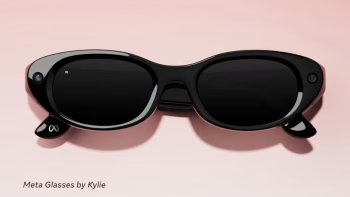
On June 23, 2026, Meta and EssilorLuxottica unveiled Meta Glasses, a new line of smart eyewear. After Ray-Ban Meta and Oakley Meta, it is the first time the wearable carries Meta’s own name — a sign that connected eyewear is establishing itself as a standalone optical category rather than a piece of technology grafted onto […]

Linda Farrow doesn’t do nostalgia. With the Iconic Collection, the British house revisits its founding vocabulary — the forms that defined it in 1970 — and reengineers them for a generation that never saw the originals. This is not a reissue. It is a restatement. A Return to Origins That Refuses to Romanticise Founded in […]