
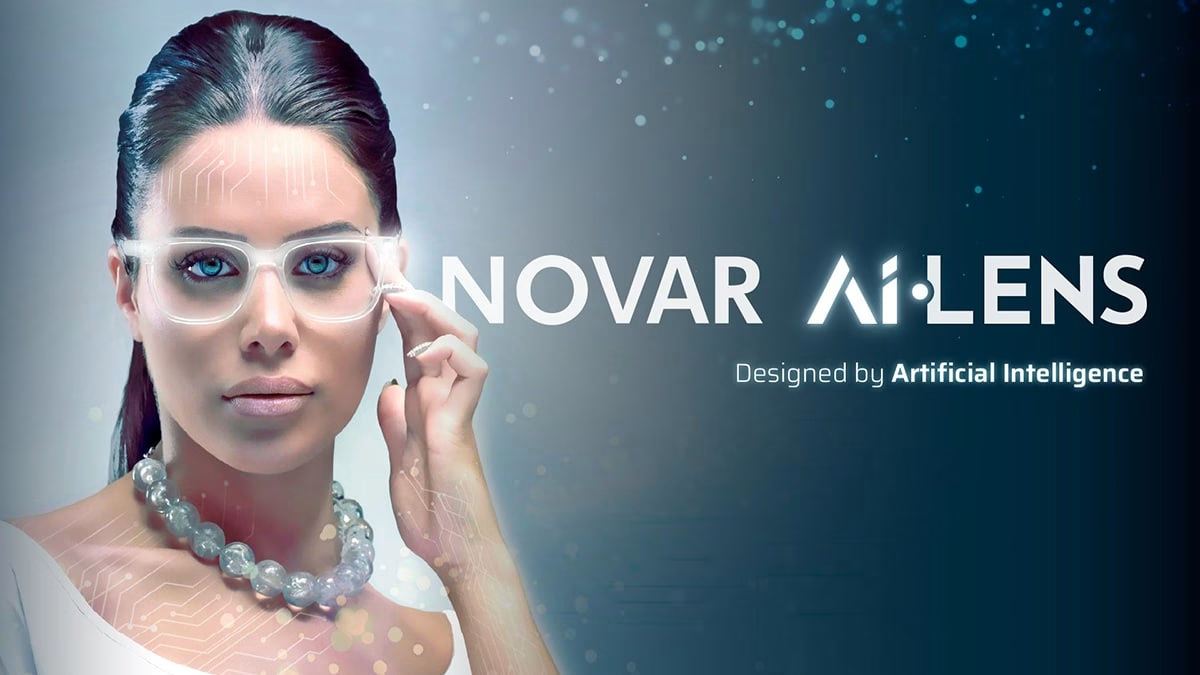
The First Progressive Lens Designed by Artificial Intelligence

The First Progressive Lens Designed by Artificial Intelligence

The AI-designed progressive lens represents a major breakthrough in the history of optical design. For the first time, a progressive eyewear lens has not been created through traditional human-led optimization, but through an evolutionary process driven by artificial intelligence. This approach introduces a fundamental shift in paradigm: instead of refining existing models, the algorithm explores millions of possible surface configurations to allow entirely new optical solutions to emerge, selected solely on the basis of visual performance.

What Is an AI-Designed Progressive Lens?

Unlike so-called “digital” progressive lenses, whose surfaces are calculated and optimized using parameters defined by optical engineers, an AI-designed progressive lens relies on a process of autonomous design. The algorithm does not simply fine-tune an existing geometry; it generates, tests, compares and evolves progressive surfaces without direct human intervention in the creative phase.

From Biological Evolution to Genetic Algorithms

The core of this innovation is directly inspired by the principles of natural evolution. Much like Darwinian selection, thousands of progressive lens surfaces are generated as an initial population. Each “individual” is evaluated according to strict visual performance criteria, including power distribution, visual stability, aberration control and overall wearer comfort.

The most effective surfaces are retained and combined, while less efficient ones are discarded. With each generation, the system learns, adapts and improves. This iterative process allows the exploration of optical design spaces that are inaccessible through conventional human-driven approaches.

Evolutionary Design Applied to Ophthalmic Optics

This evolutionary design principle breaks away from traditional linear development logic. Where classical optical engineering relies on successive adjustments and predefined constraints, artificial intelligence operates in a non-intuitive way, often challenging established design assumptions. The outcome is not a variation of an existing lens, but a fundamentally new surface geometry generated through large-scale mathematical exploration.

The AI-designed progressive lens thus becomes the product of an emergent intelligence, shaped by measurable performance objectives rather than historical design compromises or aesthetic conventions.

Visual Performance and Adaptation Comfort

One of the key challenges of progressive lenses remains wearer adaptation. By continuously evaluating millions of visual scenarios, artificial intelligence is able to optimize the continuity of visual zones while minimizing peripheral distortions. Visual comfort is no longer the result of compromise, but the direct consequence of a rigorous selection of the most effective optical solutions.

This approach also enables greater coherence between distance, intermediate and near vision, with smoother transitions between functional areas of the lens.

A Break from Traditional Digital Progressive Lenses

Digital progressive lenses represented a significant step forward by enabling high-precision manufacturing. However, their design is still based on optical models created by humans. The AI-designed progressive lens goes further: it does not simply calculate more accurately — it designs differently.

Where digital technology refines, artificial intelligence explores. This fundamental distinction opens the door to previously unimagined geometries, free from the cognitive and methodological limits of traditional lens design.

Toward a New Generation of Personalized Vision

In the long term, artificial intelligence applied to progressive lenses points toward a more adaptive and personalized vision experience. By integrating large volumes of data and continuously refining its models, AI may enable lenses that respond more precisely to individual visual profiles while maintaining a universal foundation of optical performance.

This evolution does not replace human optical expertise; it complements it. Opticians and engineers remain essential for interpretation, validation and clinical integration of solutions generated through advanced computational intelligence.

The AI-designed progressive lens ultimately inaugurates a new era in optical design. By relying on evolutionary algorithms rather than inherited models, it opens an unprecedented field of innovation. More than a technological improvement, it represents a fundamental shift in how vision itself is conceived.
Further reading :

Top 5 Men’s Sunglasses for 2026: Must-Have Models

In 2026, men’s sunglasses move toward a clearer, more controlled aesthetic. Lines become more precise, volumes more structured, and colors favor depth over immediate impact. The frame acts as a balancing element: it defines an overall look without overpowering it. This shift reflects a stronger search for coherence. Sunglasses are designed to accompany the men’s […]

Top 5 Women’s Sunglasses for 2026: Must-Have Styles

Women’s sunglasses 2026 move toward a more refined vision of style. Lines are cleaner, proportions are better balanced, and colors feel more nuanced. The accessory asserts itself without overpowering the silhouette. It frames the face, structures an outfit, and enhances personal style with restraint. This year favors thoughtful choices: frames designed to last, adaptable to […]

EssilorLuxottica x Chips-IT: A Strategic Alliance for Connected Eyewear

EssilorLuxottica has announced a strategic collaboration with Italian foundation Chips-IT to strengthen the development of customized chipsets for its connected eyewear. The goal is to accelerate open-hardware innovation and push the boundaries of performance, customization, and user experience. What does this partnership between EssilorLuxottica and Chips-IT mean? This move marks a new phase in EssilorLuxottica’s […]

Google Smart Glasses: Where Optics and Fashion Meet AI

Google Smart Glasses are making a comeback. Over a decade after the failure of Google Glass, the company is returning in 2025–2026 with a radically different approach: an ecosystem strategy that places Artificial Intelligence (Gemini) and design (Gentle Monster, Warby Parker) at the heart of the product. The goal is no longer to launch a […]

Samsung Galaxy XR 2025: Samsung unveils its immersive headset powered by multimodal AI

Samsung has launched the Galaxy XR 2025, a next-generation headset built on Android XR—developed in partnership with Google and Qualcomm. Designed for extended reality and multimodal AI, it marks the beginning of a new era of immersive interactions, blending entertainment, productivity, and exploration. What makes the Samsung Galaxy XR 2025 truly different? The Galaxy XR […]

Top Eyewear Trends Fall-Winter 2025: Oversized, Wire, Smart

The Top eyewear trends for Fall-Winter 2025 reflect a market that has become both design-driven and tech-aware.According to Euromonitor (Sept–Oct 2025), the global eyewear industry exceeds USD 160 billion this year, growing by +4.8% in value. The market is polarizing: while value-seeking consumers prioritize affordability and practicality, premium segments are investing in quality, sustainability, and […]

Adventure Whale AR, Smart Glasses Reinventing Reading for Dyslexic Children

Designed by Taiwanese designer Shih Ming-Sheng, Adventure Whale AR smart glasses combine augmented reality and generative AI to support children with dyslexia in learning to read. Awarded at the Red Dot Design Concept Awards, the project blends real-time text recognition, phonetic assistance, and gamification to turn reading into an intuitive and motivating experience. What exactly […]

Even G2: smart glasses designed for everyday use

Unveiled exclusively to subscribers, the Even G2 smart glasses combine discreet design, heads-up color display, and iOS/Android compatibility. This second-generation model by Chinese brand EVEN refines the concept of a visual wearable that’s camera-free, microphone-free, and made for real-life daily use. How does the Even G2 blend in while standing out? The G2 adopts a […]

Even G2 Launch: Mixed Reality Moves Into High Gear

Even Realities has officially announced an event for November 12 on YouTube, teasing a mysterious new product: the Even G2. Marketed as a major leap forward in XR, this upcoming model remains largely under wraps but is already stirring curiosity in immersive tech circles. What does the Even G2 teaser actually reveal? Only a banner […]

FAQ : The First Progressive Lens Designed by Artificial Intelligence

Is this a contact lens?

No. This is a progressive ophthalmic lens designed for eyeglasses, not a contact lens.

How does artificial intelligence change lens design?

Artificial intelligence generates and evolves progressive lens surfaces autonomously, rather than optimizing a predefined human model.

Is this lens more comfortable than traditional progressive lenses?

The AI-driven design aims to improve visual continuity and reduce compromise, enhancing overall adaptation comfort.

Does AI replace optical engineers?

No. Artificial intelligence is a powerful design tool that complements human expertise rather than replacing it.

Does this technology enable more personalized vision?

Yes. Evolutionary design makes it possible to develop lenses better adapted to a wide range of individual visual needs.

Don't miss any trends!

Receive exclusive updates on the latest in the world of eyewear, our favorite selections, and unique offers reserved just for our subscribers. Join the Parisée community and elevate your style today!


* indicates “required”
Parisee - Tendances Lunettes

Photo : Lumiprod